
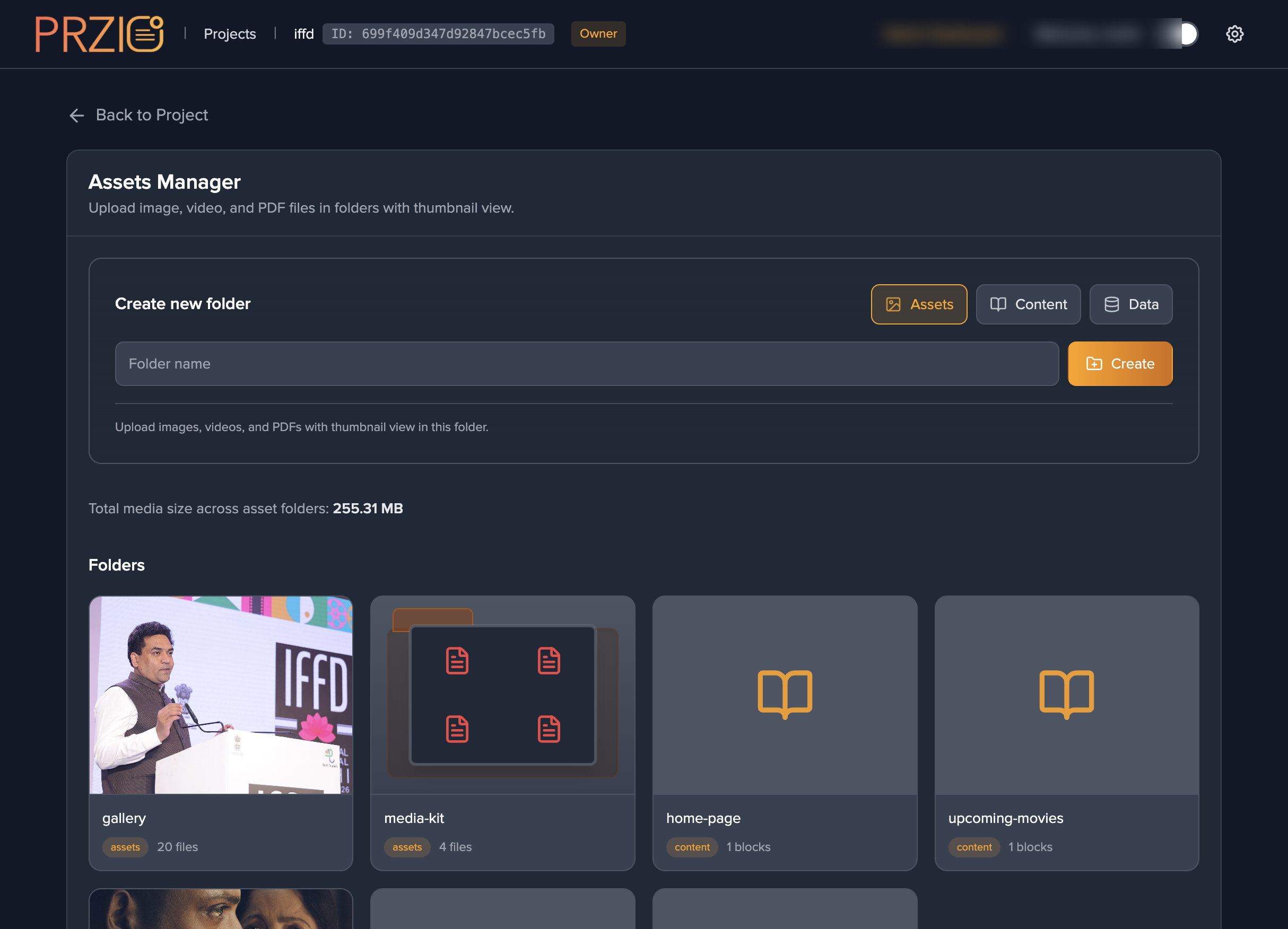
Assets folders
Store binaries with thumbnails; copy stable URLs into templates. Total media size rolls up across asset folders. ZIP uploads can be extracted in-place.
Assets Manager
Organize campaign files, marketer-owned content blocks, and server-ingested data tables from the same PRZIO workspace. Copy stable URLs, fetch structured content, or post rows through guarded APIs.
Toggle Assets, Content, or Data when you create a folder—each type has its own editor, API shape, and integration path. See the full integration guide for REST, SDK, and data-session details.
Images, video, PDFs, and ZIP unpack. Drag-and-drop, optional HTTPS image URLs from your domain, thumbnails, and copyable CDN URLs for campaigns and on-site experiences.
Marketing edits named blocks inside a content folder—each block can have top-level fields or columns for multi-column layouts (e.g. hero + sidebar). Field types include text, rich text, image URLs, lists, numbers, booleans, and json for nested config. Your site fetches via GET /api/projects/…/assets?folderId&blockId (or blockName) or PrzioSDK.Content from sdk.js—no redeploy when copy changes.
Data folders hold one or more tables. You define keys (column names) with rules like unique, required, and max length. At creation you receive a one-time write key; your backend swaps it for a short-lived JWT via POST …/data/session, then POST …/data/rows with Authorization: Bearer—so browsers never see the write key. Optional read/share keys in the UI for safer reads.
Screens below map to Assets (grid + file folder), Content (structured-block helper + editor outputs), and Data (table keys + write path). Wire folder/block/table IDs into email HTML, PrzioSDK.Content, or your backend session + rows API using Assets integration.
Store binaries with thumbnails; copy stable URLs into templates. Total media size rolls up across asset folders. ZIP uploads can be extracted in-place.
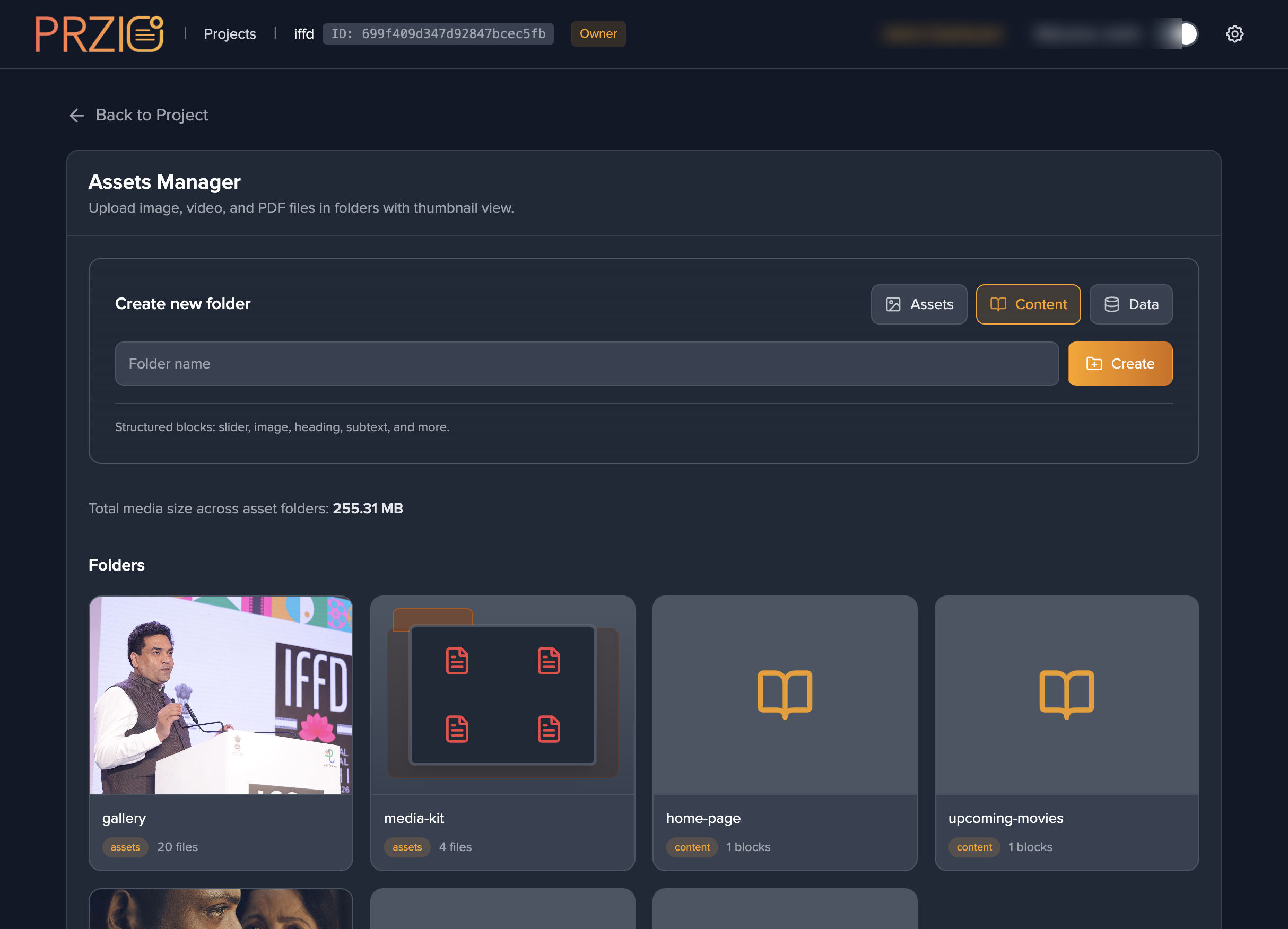
The UI hints at what you can model: sliders, images, headings, subtext, and more. Each block gets stable block IDs and optional names for REST. Use the full folder for a page package, or fetch a single block for one section—ideal for homepages, “upcoming” rails, and JSON-driven widgets. Editors iterate in the block editor; production keeps calling the same ids.
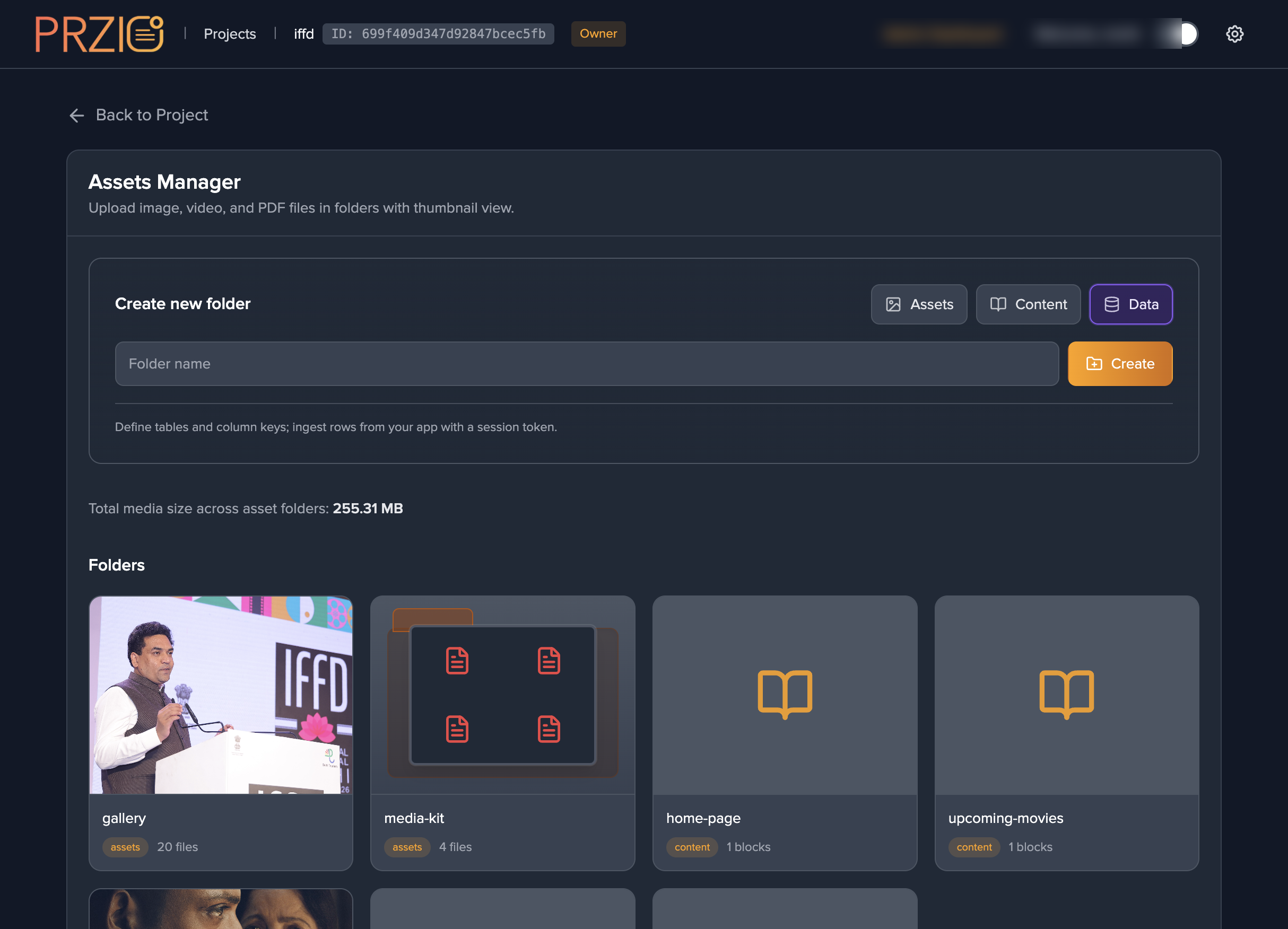
Create one or more tables per folder; define keys and optional row constraints (required, unique, max length). Ingest from your app after exchanging the write key for a data session token (~30 minutes)—never expose the write key to the browser. Inspect recent rows in the UI; upsert from backends or workers using match on your chosen keys.
Content is for editorial structured copy and layout fields your team changes often—ideal when humans publish and engineers only wire fetch/render. Data is for tabular rows your systems append or upsert (signups, SKUs, schedules)—ideal when machines write and dashboards or campaigns read. Same Assets Manager; different APIs and guardrails.
Think “CMS slices” without running a separate CMS. Editors arrange blocks; developers render contentBlocks[] from the API or pull one block by id.
json fields for flexible structures (carousels, feature flags) and parse with PrzioSDK.Content.parseJsonField in the browser.Details: PrzioSDK.Content and REST query params.
Think “project-owned spreadsheet” with an HTTP write path. You define the schema (keys); apps send rows with a session JWT, not the raw write key.
POST /api/projects/:id/data/session with folderId, tableId, and writeKey → returns token for ~30 minutes.POST /api/projects/:id/data/rows with Authorization: Bearer <session> and a match object for upsert semantics (match on one or more key columns).Details: Data · session & rows.
Same storage surface—media URLs for creative, content folder ids for headless sections, data tables for operational rows—each wired into the tools that already read PRZIO project context.
Keep finals-approved logos, hero shots, and PDFs off shared drives. Folder thumbnails show what’s current before anyone copies a URL into email HTML.
Paste hosted asset links into the email editor so tracked sends reference files managed from one workspace—not scattered uploads.
Pick gallery imagery for modal layouts or personalization variants without asking engineering for another deploy.
Large poster grids or seasonal swaps stay organized; ZIP uploads unpack into folders when you need dozens of assets at once.
Upload archives and extract supported formats into the folder so batches behave like first-class files.
Store hero copy, promo strips, and JSON configs in content blocks. Your Next.js, Shopify theme, or static site pulls by folder or block id—marketers publish without a deploy.
Capture event signups, SKU lists, or slot bookings into a data table. Backend exchanges the write key for a session token and POSTs rows; PRZIO keeps the audit trail and column rules.
Four beats—open the tool, create the right folder type, model content blocks or data tables, then ship media (ZIP/URLs) while Content/Data go live via API. Captured on project iffd in production.
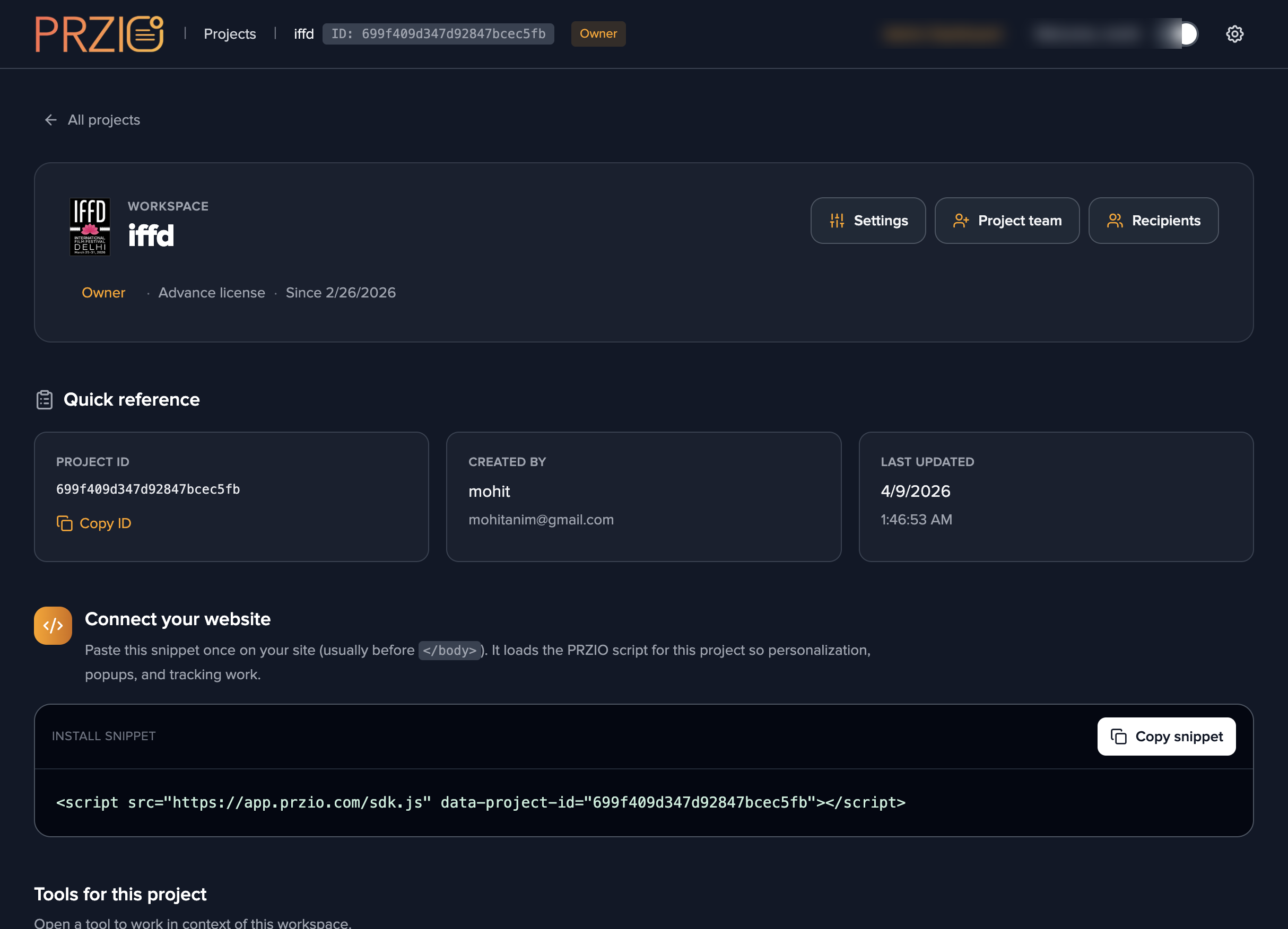
From your project dashboard, open Assets under Website experience. Every folder you create is scoped to this project—same ID as your snippet’s data-project-id.
The Content and Data toggles change the helper text: content folders describe structured blocks; data folders describe table keys and session-based ingest. Assets stays on media. The grid badges read content, assets, or data so the team always knows what’s inside.
In a Content folder, add blocks and fields (or column layouts), then copy folder ID + block ID into your fetch layer—REST or PrzioSDK.Content. In a Data folder, define tables and keys; capture the one-time write key in your backend only, mint session JWTs, and POST rows with upsert match semantics.
For Assets folders: drag files onto the drop zone, add hosted image URLs, or upload ZIPs and extract. Each file exposes replace, delete, metadata, and copy asset URL for downstream templates. (Content ships through the block editor; Data ships through your API after session exchange.)
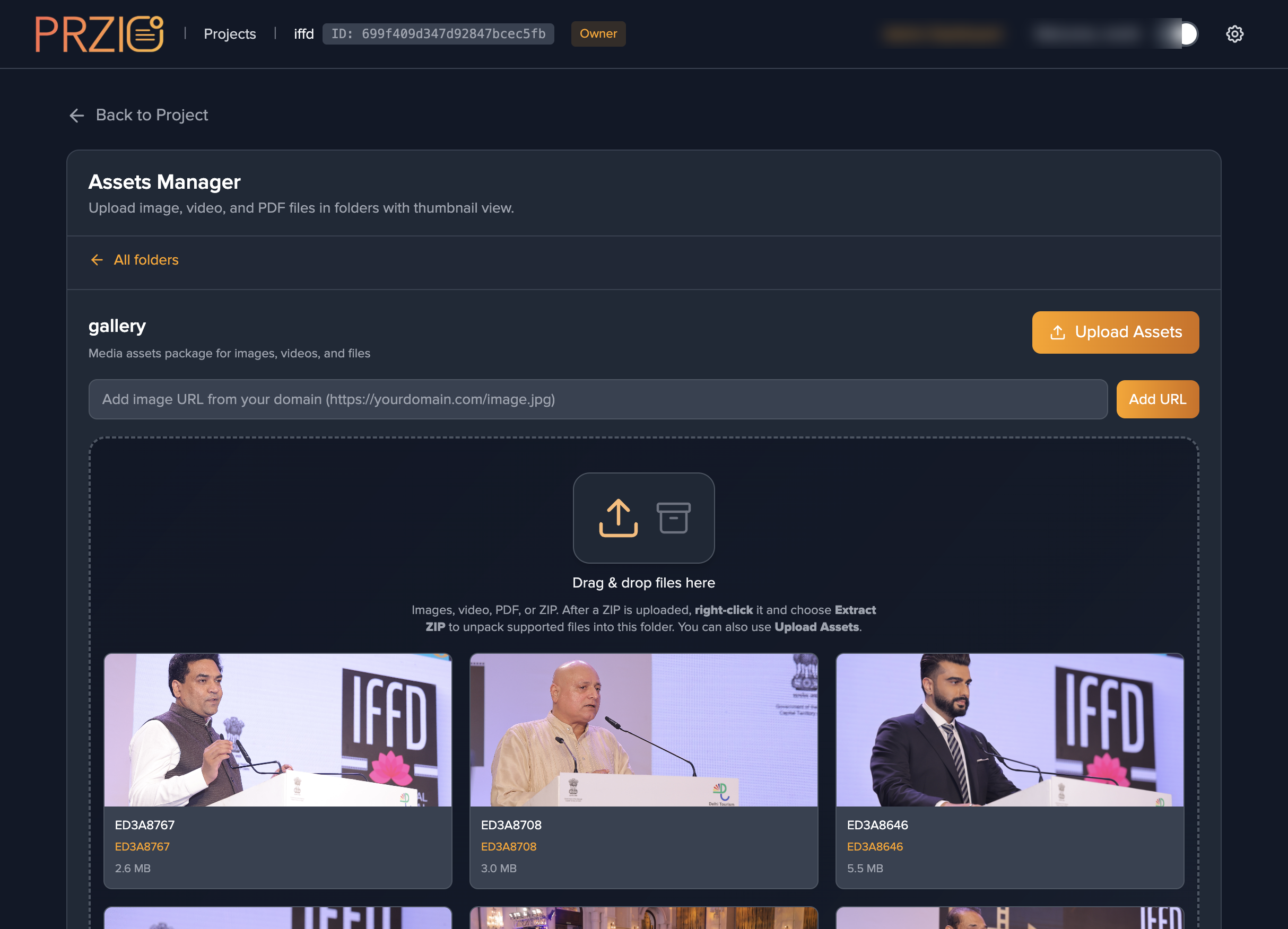
Open Assets Manager for project 699f409d347d92847bcec5fb (or your own). Use Content folders for marketer-owned blocks and Data folders for server-ingested rows; the integration guide covers REST list/fetch, PrzioSDK.Content, session tokens, and row upserts.
Copyright © 2026 PRZIO. All rights reserved.