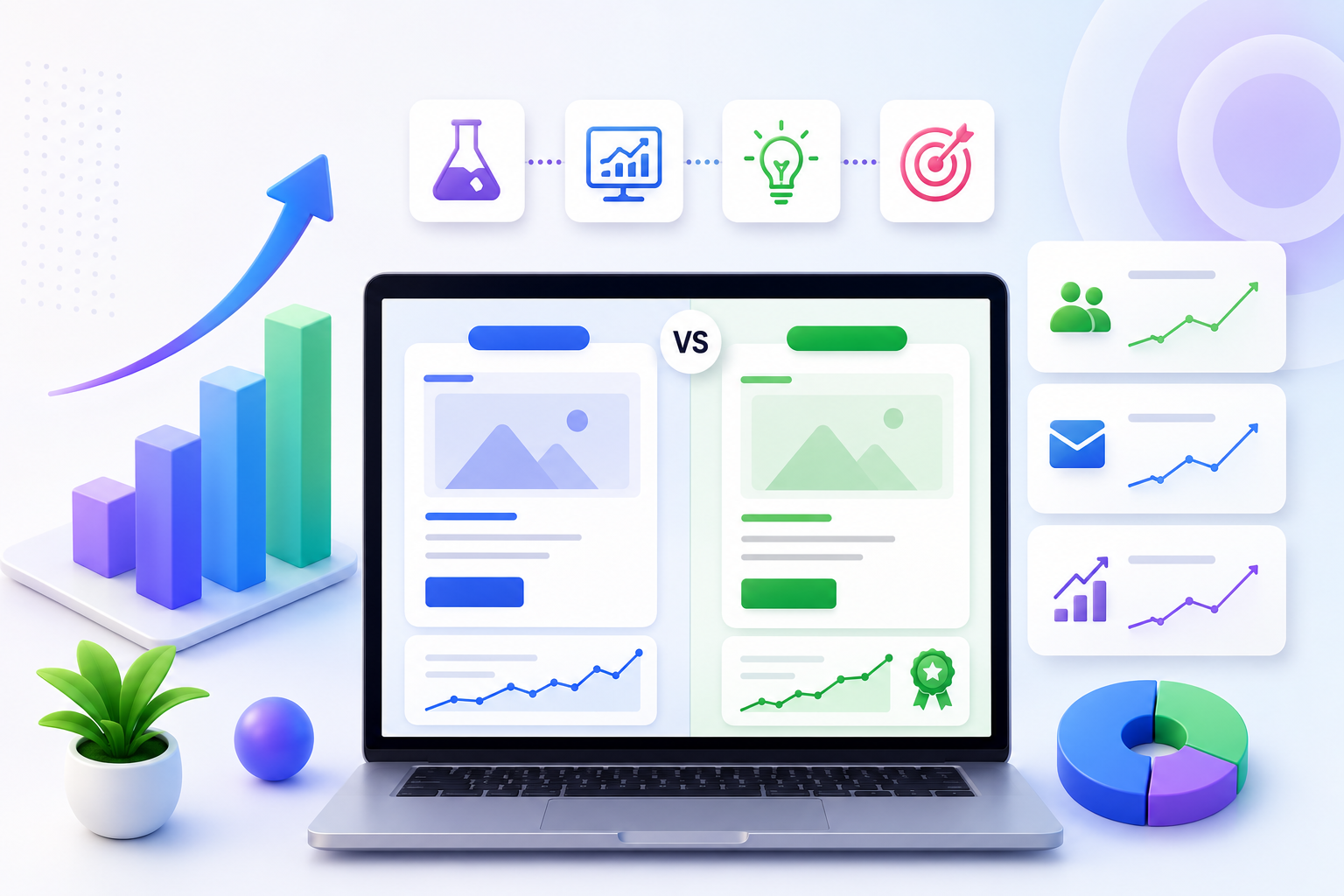
Increasing website traffic is valuable, but visitor volume alone does not create growth. Your website must also turn the right visitors into subscribers, leads, or customers. A structured experimentation program can improve both acquisition and conversion by helping your team learn which messages, experiences, and offers motivate people to act.
Conversion experiments do not automatically generate new traffic. However, they can make campaigns more effective, increase repeat visits, and reveal which audience segments deserve additional investment. The best strategy combines traffic-generation tests with onsite conversion experiments and reliable measurement.
Start With a Clear Conversion Goal
Before changing a headline or launching a popup, define the primary action you want visitors to complete. This might be submitting a contact form, requesting a quote, joining an email list, creating an account, or purchasing a product.
Use the PRZIO Website Tracker to measure important events across the customer journey. Track landing-page views, product interactions, form starts, form submissions, and purchases. These events help identify where visitors lose interest and which pages offer the greatest opportunity.
Choose one primary metric for each experiment. Supporting metrics can provide context, but testing too many goals at once makes results difficult to interpret.
Conversion Experiments Worth Running
1. Test Your Main Value Proposition
Your homepage and landing-page headlines should quickly explain what you offer, who it helps, and why it is useful. Test a feature-focused headline against an outcome-focused alternative. For example, compare a general description of your service with a headline promising a specific business result.
Keep the layout, traffic source, and call to action consistent so the headline remains the main variable. Measure clicks, form submissions, and downstream conversions rather than relying only on time on page.
2. Simplify Lead-Capture Forms
Long forms can reduce completion rates, especially for first-time visitors. Test a short form requesting only a name and email address against your current version. Additional information can be collected after the first conversion or during a sales conversation.
With PRZIO Forms, lead details can flow into shared audiences and email campaigns. Experiment with form placement, field count, button wording, and the supporting message. A specific call to action such as Get My Free Assessment often communicates more value than Submit.
3. Compare Calls to Action
Test one meaningful CTA variable at a time. Useful experiments include changing the offer, wording, location, or visual prominence. Place the primary CTA near the top of the page, then repeat it after sections that address benefits, proof, and common objections.
A service business might compare Book a Consultation with See How It Works. An ecommerce site could compare Shop Best Sellers with Explore the Collection. The winning option depends on visitor intent, so segment results by traffic source and audience whenever possible.
4. Personalize Pages by Audience
Visitors arriving from an email campaign may know your brand, while people coming from search may need more explanation. Sending both groups to an identical experience can limit conversions.
PRZIO A/B Testing and Personalization helps teams create audience-based page variants and controlled experiments. You can show returning visitors a loyalty offer, present location-specific information, or align landing-page copy with the advertisement that generated the visit.
5. Test Trust and Proof Elements
Place testimonials, customer outcomes, delivery details, guarantees, or security information near moments of hesitation. Test proof related directly to the visitor's decision rather than adding generic badges throughout the page.
For example, a testimonial about implementation speed may perform better beside a demo CTA, while ratings and delivery information may be more persuasive near an ecommerce purchase button.
Experiments That Can Increase Qualified Visitors
To grow traffic, test acquisition channels and content rather than relying exclusively on onsite changes. Build landing pages around specific customer problems, publish useful answers to high-intent search questions, and compare promotional messages across email and social campaigns.
How to Run Reliable Website Experiments
- Identify a measurable problem using website activity data.
- Write a hypothesis that predicts the change and expected outcome.
- Select one primary conversion metric.
- Create a meaningful variant without changing unrelated elements.
- Run the test across a representative period and avoid stopping it after an early result.
- Review performance by audience and traffic source.
- Document the result, implement confirmed improvements, and use the insight to plan the next test.
Strong experimentation is not a sequence of random design changes. It is a repeatable process for learning what helps each audience move forward.
Frequently Asked Questions
Which website experiment should I run first?
Start with a high-traffic page that has a clear conversion goal and an obvious point of friction. Testing its value proposition or CTA can produce more useful evidence than changing a low-traffic page.
How many elements should I change in one test?
For a standard A/B test, change one central concept at a time. A complete page redesign can be tested, but it will not reveal which individual element caused the result.
Should I optimize traffic or conversions first?
Do both in a coordinated way. Fix major conversion barriers before purchasing substantially more traffic, then test acquisition channels based on qualified leads or revenue rather than visits alone.
Turn More Website Visits Into Growth
Want to integrate this into your storefront or website? PRZIO helps you ship hosting, personalization, campaigns, and recommendations from one platform. Explore PRZIO A/B Testing and Personalization or book a PRZIO demo to discuss an experimentation strategy for your website.