
Challenge
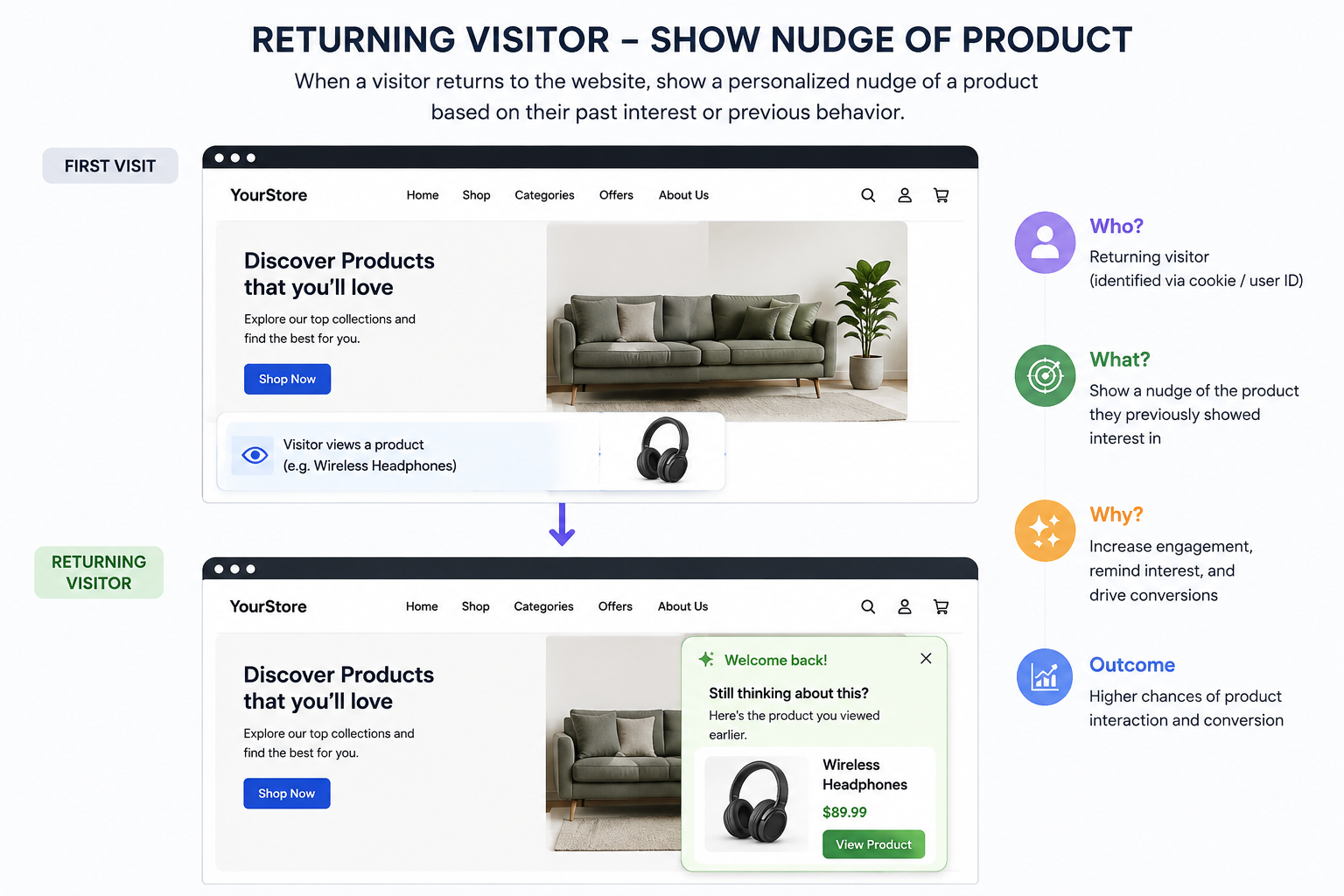
Many ecommerce visitors browse a product detail page, compare options, and leave without adding anything to cart. When they return days later, the site often treats them like a new visitor: the homepage is generic, the product they considered is difficult to find, and the buying intent has cooled. This creates unnecessary friction precisely when the shopper may be ready to decide.
The goal is not to follow every visitor with an intrusive discount. It is to recognize a returning visitor who viewed a specific product, confirm they have not purchased it, and give them a helpful, timely route back to that product. The nudge should feel like useful continuity: “Still considering this?” rather than pressure.
Approach
1. Define the high-intent returning-visitor segment
Track a product-detail-page view with the product ID, product name, category, price, and timestamp. Create a segment for visitors who viewed a product in the last 7 to 14 days, returned to the site, and have not completed an order for that product. Exclude people who already added the item to cart in the current session, purchased recently, or have seen the nudge more than twice.
Use the PRZIO Website Tracker to capture the viewed-product event and returning-session activity. Then use the PRZIO Audience Manager to build a reusable audience that can be activated across onsite campaigns and follow-up channels.
2. Choose a nudge based on where the visitor returns
3. Personalize the message, not just the placement
Use the product data to make the nudge specific. For example: “Welcome back — your linen overshirt is still available in navy” or “Still comparing espresso machines? Resume with the model you viewed.” For products with longer consideration cycles, add decision support such as a buying guide, comparison link, or customer-review summary. For fast-moving inventory, use truthful urgency only when the stock signal is reliable.
How PRZIO helps
Build the experience as an audience-based page variant with PRZIO AB Testing & Personalization. Serve the nudge only to the returning viewed-product audience, while keeping the default page unchanged for everyone else. Pass the last viewed product into the variant so the copy, image, CTA, and destination remain relevant to each visitor.
For a more prominent but controlled prompt, use PRZIO Popup Campaigns to trigger an overlay only after the visitor has shown renewed intent: for example, after 10 seconds on a return visit, after a second product-page view, or on exit intent. Set a frequency cap, suppress the popup after a cart action or purchase, and avoid showing it to visitors who dismissed it recently.
Run a clean test rather than assuming the nudge works. Compare a control group with no returning-visitor treatment against variants such as a homepage reminder, a PDP reassurance bar, and an exit-intent save-for-later prompt. Measure product return rate, add-to-cart rate, checkout starts, completed orders, revenue per returning visitor, and any impact on bounce rate. Break results down by device, product category, and time since the original product view.
A useful nudge reduces the effort of picking up where the shopper left off; it does not interrupt them with the same message on every page.
Results and next steps
Start with one category where product browsing is common and purchase decisions take more than one session, such as apparel, furniture, beauty, or electronics. Launch a single return-visitor audience and one restrained nudge for two weeks. If the test increases return-to-product and add-to-cart rates without hurting conversion elsewhere, expand to additional categories and tailor the reassurance message by product type.
Next, connect the onsite experience to email for visitors who identify themselves through checkout, account, or lead capture. Keep timing and message consistent so the shopper sees a coherent journey rather than duplicated promotions.
Ready to turn past product views into a more relevant next visit? Book a PRZIO demo to plan the audience and measurement setup, then explore PRZIO AB Testing & Personalization for the onsite experience.
What users ask
Common questions teams ask before shipping this play.
How long should someone remain eligible after viewing a product?
Start with 7 to 14 days, then test shorter windows for impulse purchases and longer windows for considered purchases.
Should we offer a discount in the first returning-visitor nudge?
Usually no. Begin with product continuity and decision-support content; reserve offers for a tested segment with strong intent and no conversion.
What events should suppress the nudge?
Suppress it after purchase, an active cart action, a recent dismissal, or when the visitor has already seen the campaign at its frequency cap.
Can this work for anonymous visitors?
Yes. Use browser-level returning-visitor and product-view behavior onsite, then stitch identity when a visitor submits a form, logs in, or checks out.
What is the most important success metric?
Use incremental completed orders or revenue per eligible returning visitor, supported by product return rate and add-to-cart rate.