
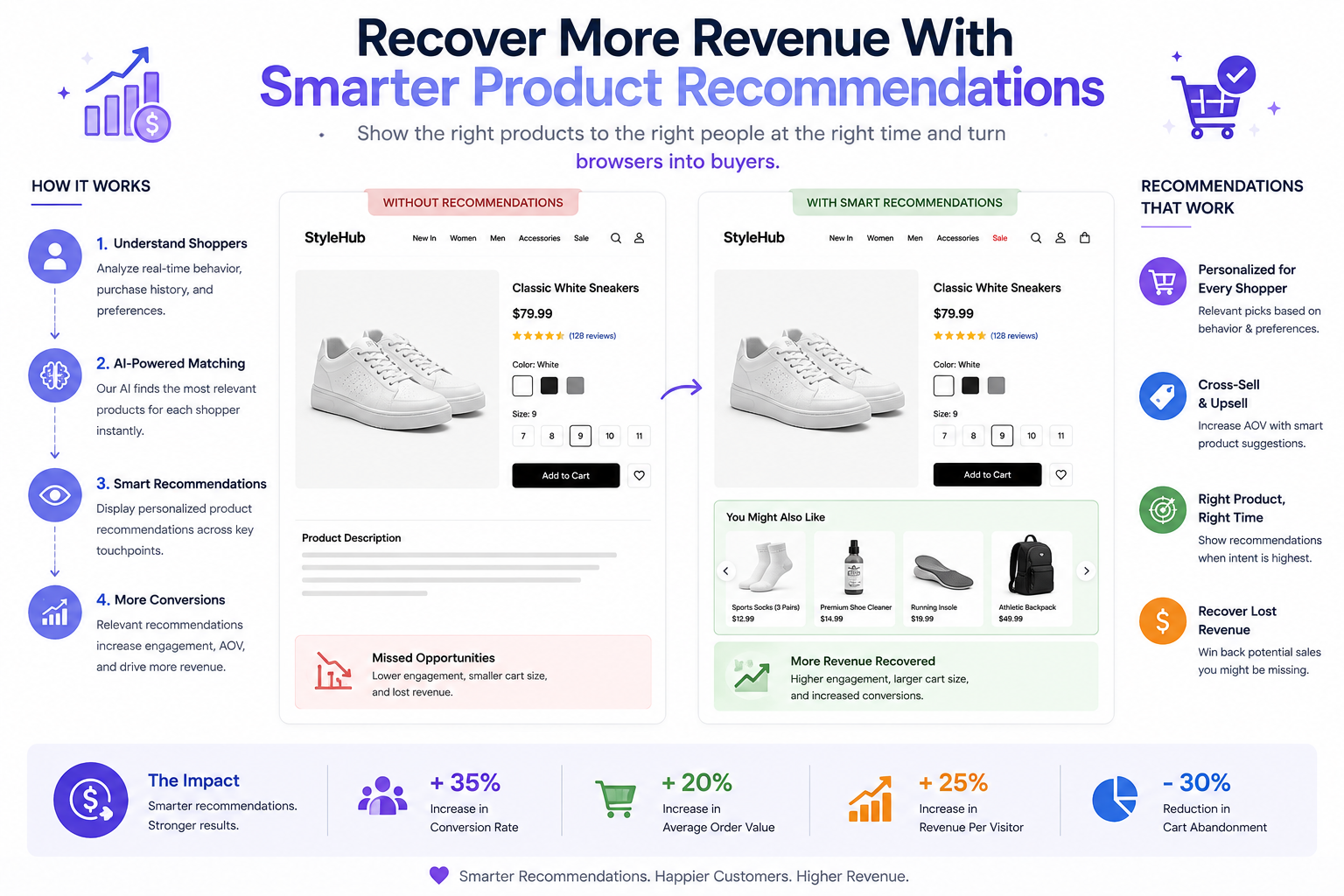
Product discovery often breaks when shoppers leave a category page, compare several options, or abandon a cart. A strong recommendation strategy keeps the next relevant product visible at every moment: on the homepage, product detail page, cart, and recovery journey. With PRZIO Product Recommendations, ecommerce teams can turn browsing and purchase signals into practical merchandising blocks that make returning to buy feel easy.
Challenge: shoppers browse, hesitate, and disappear
Many stores show the same generic bestseller carousel to every visitor. That misses valuable intent signals. A shopper who viewed three running shoes needs different suggestions from someone who recently purchased a yoga mat. Likewise, a cart abandoner may need a complementary item, a lower-priced alternative, or a simple reminder of what they considered.
The growth challenge is to make recommendations useful without creating clutter. Teams need to decide which module belongs on each page, how often products should refresh, and how to measure whether a recommendation created incremental revenue rather than merely receiving credit for an inevitable purchase.
Approach: build a recommendation journey around intent
1. Start with Most Viewed products
Use a Most Viewed module on the homepage or high-traffic category pages to help new visitors discover products attracting current interest. Refresh the module regularly so seasonal demand, launches, and campaigns are represented. This works especially well when visitors have no previous shopping history.
2. Add “Viewed This, Viewed That” on product pages
Place a “Viewed This, Viewed That” block below product details. It uses co-viewing behavior to show items shoppers commonly investigate together, such as a camera body with compatible lenses or a sofa with matching chairs. These suggestions support comparison and cross-sell without requiring the shopper to start a new search.
3. Restore intent with Recently Viewed
Returning visitors should not have to remember the products they considered yesterday. Add a Recently Viewed row to the homepage, account area, and cart drawer. Keep it focused on a small set of items and exclude products that are out of stock or already in the cart.
4. Personalize after purchase
A “Similar to Recently Purchased” module is useful after checkout, in account pages, and in follow-up campaigns. Recommend compatible replenishments, upgrades, or adjacent collections instead of repeating the exact product a shopper already owns. For example, a customer who purchased a moisturizer could see a compatible cleanser, refill, or travel-size version.
5. Use recommendations to recover cart abandonment
Cart abandonment is not always a rejection. A shopper may be distracted, uncertain about fit, or still comparing options. In an abandoned-cart email or onsite return experience, show the abandoned item first, then one or two highly relevant alternatives or add-ons. Connect this with PRZIO Email Editor & Campaigns to use the same audience and product logic across onsite and email recovery.
How PRZIO helps
PRZIO brings recommendation logic into the places that affect revenue most: product pages, carts, homepages, and campaigns. Use Website Tracker to capture views, clicks, cart activity, and purchases, then evaluate which modules drive product discovery, add-to-cart rate, and revenue per session.
Teams can also use recommendation insights to improve SEO page strategy. High-engagement product relationships reveal how people actually search and compare products. Build unique, descriptive title-tag patterns for category and collection pages using product type, brand, use case, and relevant attributes. For example, instead of a vague title such as “Shop Shoes,” use “Men's Trail Running Shoes for Wet Weather | Brand.” Recommendation data can help prioritize categories and internal links worth improving, but title tags should remain unique, accurate, and written for searchers rather than stuffed with keywords. This supports stronger relevance and crawlable product discovery; it does not guarantee rankings on its own.
Use PRZIO Audience Manager to separate first-time visitors, repeat browsers, recent purchasers, and cart abandoners. Each group can receive a different recommendation mix, helping merchandising feel relevant rather than repetitive.
Results and next steps
Launch with two or three modules, not every recommendation type at once. Track recommendation click-through rate, add-to-cart rate after a recommendation click, conversion rate, average order value, and recovered cart revenue. Test placement, product count, labels, and the balance between substitutes and complementary products. Remove modules that distract from the primary purchase path.
Start with Most Viewed for discovery, Recently Viewed for return visits, and cart-specific alternatives for abandonment recovery.
Ready to turn behavioral signals into practical merchandising? Book a PRZIO demo to plan your rollout, then explore PRZIO Product Recommendations for homepage, PDP, cart, and recovery use cases.
What users ask
Common questions teams ask before shipping this play.
How many recommendation blocks should we launch first?
Start with two or three high-intent blocks, then expand after measuring clicks, conversion, and revenue impact.
Can we exclude out-of-stock or already purchased products?
Yes. Set product eligibility rules so recommendations stay useful and do not promote unavailable or irrelevant items.
What should cart abandoners see?
Show the abandoned product first, followed by one or two relevant alternatives, accessories, or lower-friction options.
Will better title tags automatically improve SEO rankings?
No. Unique, accurate title tags improve relevance and click potential, but rankings also depend on content, technical SEO, authority, and competition.
Which metrics prove recommendations are working?
Measure recommendation clicks, post-click add-to-cart rate, conversion rate, average order value, recovered revenue, and incremental lift.